The Enduring Story of the Icon of Our Mother of Perpetual Help
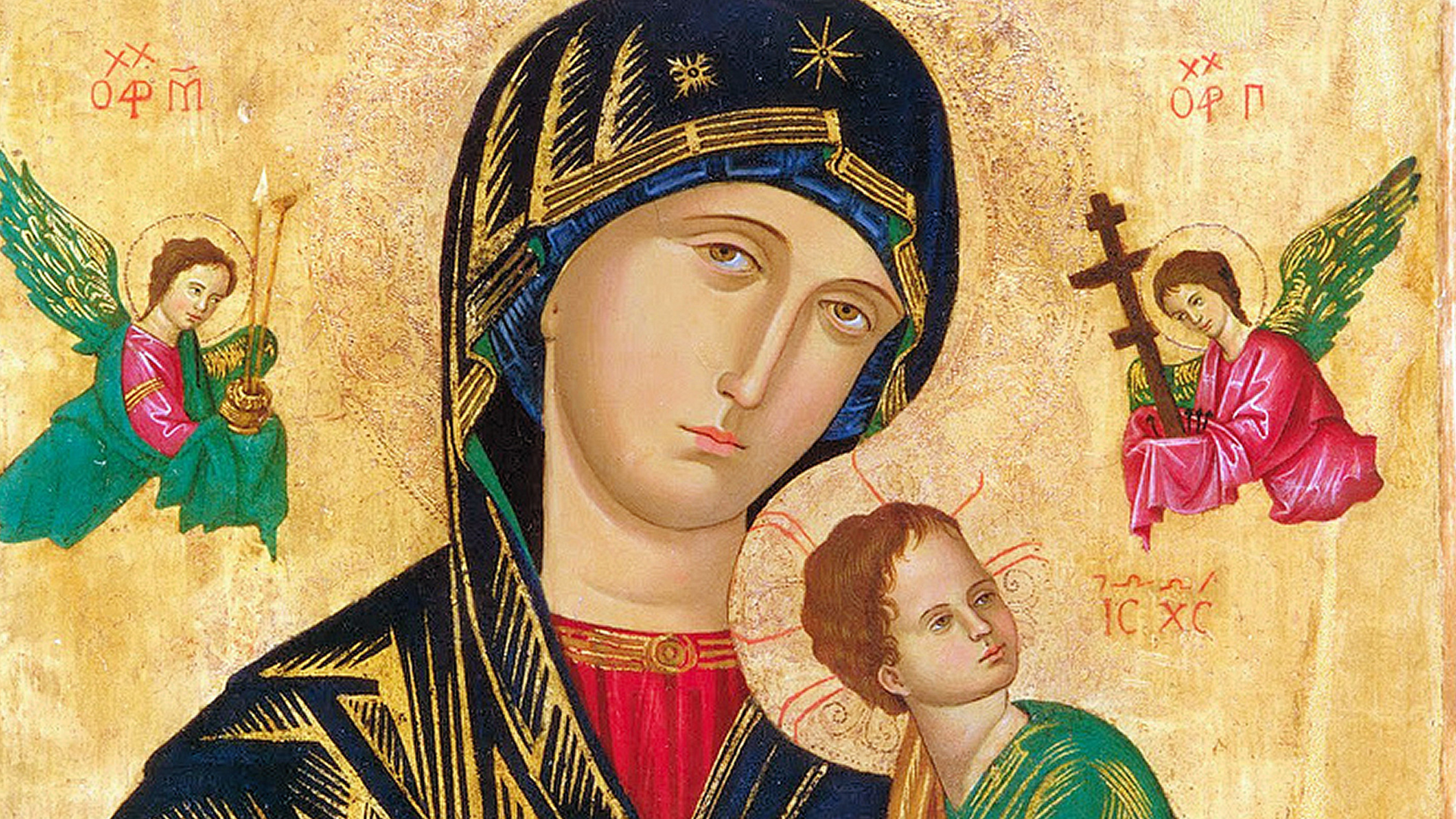
The story of the world-famous icon of Our Mother of Perpetual Help is one woven through centuries of devotion, mystery, and providence. Its journey—from a humble island in the Mediterranean to its honored place in Rome—mirrors the faith of those who guarded it and the hope of generations who continue to venerate it.
Origins in Crete
The icon’s origins can be traced back to the island of Crete around 1495. It reflects the early Marian portraits of the Christian East, many of which are attributed by tradition to Saint Luke the Evangelist. True to its Byzantine style, the image presents the Virgin Mary in solemn grace, holding the Child Jesus.
According to historical tradition, a merchant took the sacred image from Crete in the late 15th century. During his voyage to Rome, he survived a violent storm—a moment later remembered by the Redemptorists as a sign of the Virgin’s protection over both the icon and its bearer.
The Icon Comes to Rome
Living in Rome, the merchant fell gravely ill. On his deathbed, he confessed to a friend the secret of the stolen icon, pleading that it be returned to a church where it could be venerated. His friend promised, but his wife, captivated by the icon’s beauty, refused to part with it. The merchant died, his wish unfulfilled.
The story might have ended there if not for the couple’s six-year-old daughter. The child said that the Blessed Virgin appeared to her, urging that the image be placed in a church between the Basilicas of Saint Mary Major and Saint John Lateran. Moved by this vision, the mother relented. On March 27, 1499, the icon was solemnly enshrined in the Church of Saint Matthew the Apostle, where it would be venerated for the next three centuries.
Centuries of Devotion and Loss
The Church of Saint Matthew, cared for by the Irish Augustinians staying in Rome, was modest in size but rich in devotion. Pilgrims flocked to pray before the icon of Our Mother of Perpetual Help, and countless favors were attributed to her intercession.
However, the peace of the sanctuary was shattered in 1798 when war swept through Rome. The church was almost entirely destroyed, and the Augustinians were forced to flee. Some went back to Ireland, others to America, while a few resettled in another monastery in Rome—the Church of Saint Mary in Posterula. They carried the icon with them for safekeeping, placing it in a private chapel where, over time, it fell into obscurity.
Only one friar, Brother Augustine Orsetti, remembered the icon’s significance. When an altar boy named Michael Marchi befriended him, Brother Augustine confided the icon’s story and told him never to forget it. The boy took the words to heart, recalling years later that he had often seen the neglected image gathering dust in the Augustinians’ chapel at Posterula.
Brother Augustine died in 1853, never seeing the icon restored to public veneration. Yet his faith and memory would soon spark the revival of the devotion he had so carefully preserved.
Rediscovery and Restoration
In January 1855, the Congregation of the Most Holy Redeemer—the Redemptorists—acquired property in Rome to serve as their general house. Unbeknownst to them, their land included the ruins of the very Church of Saint Matthew where the icon had once been venerated. Their new church, dedicated to the Most Holy Redeemer and Saint Alphonsus Liguori, was completed within four months. Among the young men who entered the new Redemptorist novitiate was none other than Michael Marchi—the altar boy who had once known the icon’s hiding place.
Years later, in February 1863, a Jesuit preacher named Father Francesco Blosi delivered a sermon in Rome about an ancient image of the Virgin once honored in Saint Matthew’s. The Redemptorists, intrigued by this account, began searching for the lost icon. Father Marchi, now a Redemptorist priest, revealed that he knew exactly where it could be found.
A New Home and a Worldwide Mission
The Redemptorist Superior General, Father Nicholas Mauron, petitioned Pope Pius IX to entrust the icon to their care so that it could return to its original site between the two great basilicas. On December 11, 1865, the Holy See granted permission, expressing the Pope’s wish that “the image of the Most Holy Mother be again placed between Saint John and Saint Mary Major.” It was also then that Pope Pius IX gave the Redemptorists their enduring mission: “Make her known throughout the world.”
In January 1866, the Redemptorists formally received the icon from the Augustinians, who were given a faithful copy in return. The original image, worn with age, required careful restoration, which was entrusted to the Polish artist Leopoldo Nowotny. When the work was completed, the icon was solemnly exposed for public veneration on April 26, 1866.
From that moment, devotion to Our Mother of Perpetual Help spread rapidly across the globe. The once-forgotten image from Crete became one of the most beloved representations of the Virgin Mary, enshrined not only in churches but also in the hearts of the faithful.
Its story—marked by theft and loss, faith and rediscovery—reminds us that the sacred often finds its way home, no matter how far it strays. The icon’s enduring presence continues to offer what its name promises: Perpetual Help for all who seek it.
Sources:
Legend, History and Symbolism of the Icon of Our Mother of Perpetual Help, February 23, 2017, https://www.cssr.news/2017/02/legend-history-and-symbolism-of-the-icon-of-our-mother-of-perpetual-help/
History of the Icon, https://www.cssr.news/perpetual-help/history-of-the-icon/
Miraculous Images of Our Lady: 100 Famous Catholic Statues and Portraits by Joan Carroll Cruz, 2012