The Redemptorists: A Mission Born in Scala, Italy
The Redemptorists, formally known as the Congregation of the Most Holy Redeemer (Latin: Congregatio Sanctissimi Redemptoris, abbreviated C.Ss.R.), is a Roman Catholic religious congregation of priests and brothers dedicated to missionary work—especially among the poor and those most abandoned.
The congregation’s motto, “Copiosa Apud Eum Redemptio” (Psalm 130:7), translates to “With Him there is Plentiful Redemption.” It reflects a deep trust in God’s boundless mercy—a belief that no one is ever beyond His reach.
The Redemptorists serve in over 80 countries across the world.
Beginnings in the Philippines
The arrival of the Redemptorists in the Philippines came at a critical time. Following the 1896 Philippine Revolution and the end of Spanish colonial rule, the Catholic Church in the country faced serious challenges. The withdrawal of many Spanish friars left numerous parishes without clergy, while the rise of new religious denominations added to the uncertainty and instability.

Fr. Andrew Boylan, C.Ss.R.
In Cebu, the local bishop, Most Rev. Thomas Hendrick, appealed to several religious congregations for help—but without success. At the same time, the Redemptorists in Ireland were planning to establish missions in the West Indies. Persuaded by two Irish bishops, Superior General Andrew Boylan redirected their focus to the Philippines. In 1904, the Irish Province decided to found a mission in Cebu.
Fr. Boylan arrived in Cebu in January 1906, and upon the bishop’s recommendation, the Redemptorists chose Opon, a small town on Mactan Island, as the site for their first mission. The Redemptorists formally took possession of Opon on March 17, 1906, and the first members of the community—five priests and two brothers—arrived on June 30, 1906.

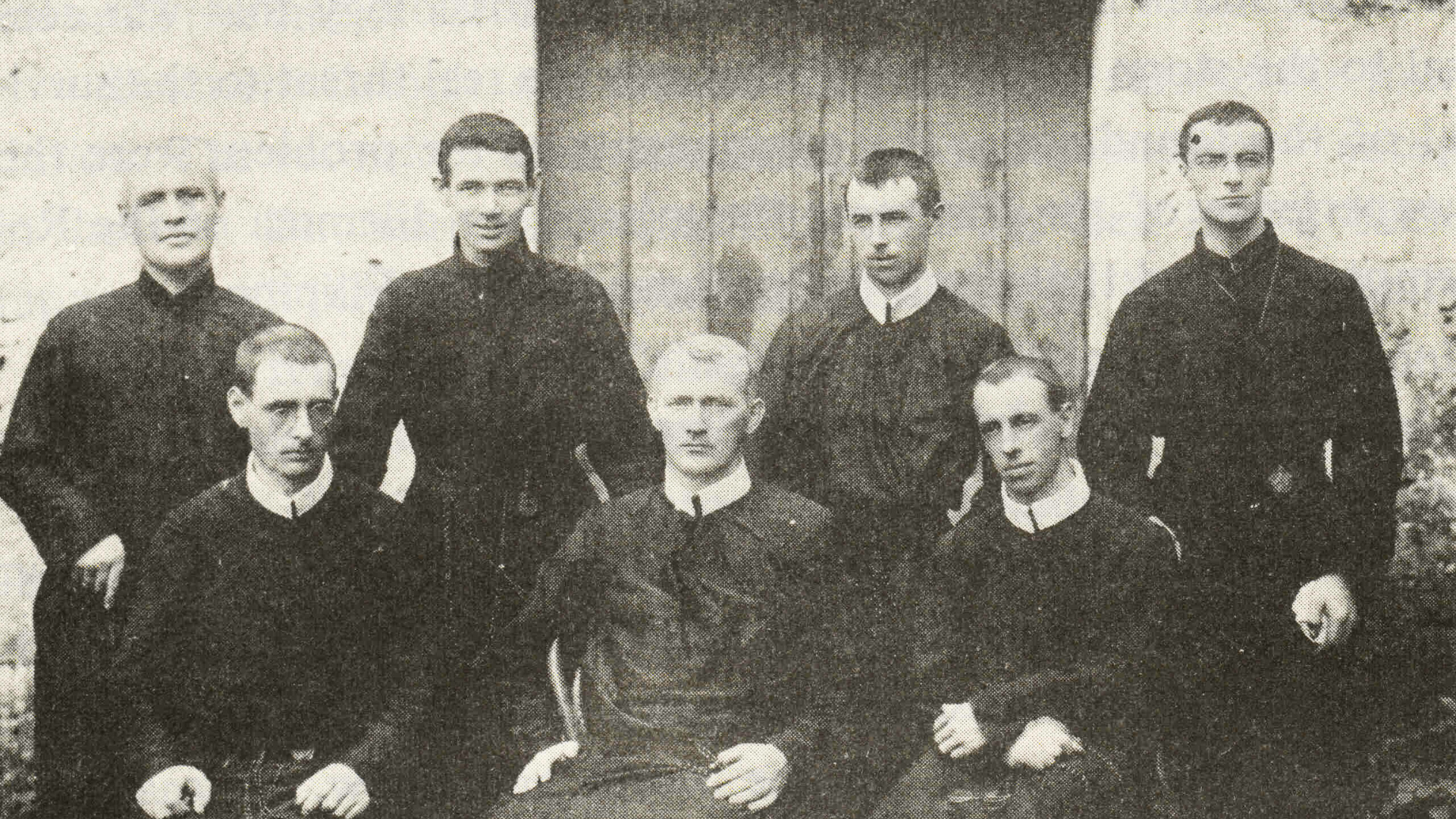
Redemptorist Community in Opon, 1907. (Left to Right, front row: Frs. Cassin, Leo, and O’Callaghan; back row: Brs. Breandan and Eunan, Fr. O’Sullivan, and Br. Casimir.)
The early days were difficult. The missionaries faced resistance and mistrust from the local people. A breakthrough came on July 24, 1906, when Fr. Patrick Leo, C.Ss.R., the community superior, placed an icon of Our Mother of Perpetual Help in the church’s tribune. The chronicles record: “It is remarkable that on this day, the people became more notably friendly toward us.” The icon, new and unfamiliar to the community, quickly became a symbol of connection and hope.

The old Opon in Cebu.
By 1916, the missionaries began moving beyond the parish to reach the rural areas of Cebu. Sermons were translated and read in the local language, confessions were heard, and house-to-house visits were made. A key element of every mission was the installation of the icon of Our Mother of Perpetual Help above the altar. By 1913, Redemptorists were already conducting missions beyond Cebu—in Bohol, Leyte, Negros Oriental, and Camiguin.
Growth in Central and Southern Philippines
In 1932, Cebu was elevated to a Vice Province. Mission centers were established in Iloilo and Cebu, followed by communities in Tacloban City (1948), Bacolod City (1950), Davao City (1952), Dumaguete City (1958), and Butuan (1973). These foundations allowed the Redemptorists to expand their apostolate across the Visayas and Mindanao.
The first Filipino to enter the congregation was Juan Corominas in 1918, though he left during his novitiate in Australia. The first Filipino Redemptorist to profess vows was Brother Gerard Santamaria, C.Ss.R., on September 8, 1945. Fr. Ramon Fruto, C.Ss.R., and Fr. Fernando Yusingco, C.Ss.R., were ordained in 1959, becoming the first Filipino Redemptorist priests.
In the 1960s, more Filipino Redemptorists joined the mission. Working side by side with Irish confreres, they expanded their apostolic work in line with the Church’s renewal after Vatican II. New parishes were established: Bacolod (1950), Iloilo and Tacloban (1967), Butuan (c.1968), Dumaguete (1970), Cebu City (1971), and Davao City (1972). Bacolod and Butuan were later handed back to their respective dioceses.
Building Basic Christian Communities (BCCs)—later called Basic Ecclesial Communities (BECs)—became the primary pastoral focus. Redemptorists also engaged in retreats and formation work, leading to the establishment of retreat houses in Cebu, Iloilo, and Bacolod. They also launched DYRF, a Catholic radio station in Cebu (later transferred to the Society of the Divine Word in 1975).
Meeting the Needs of the Times
The declaration of Martial Law in 1972 ushered in a new era of challenges. Redemptorists were compelled to re-examine their approach to mission and parish work. In 1975, the Mission Council made two key decisions:
- To recruit and train lay missionaries to work alongside Redemptorist teams.
- To experiment with community organizing as a method of building BECs.
This marked a shift toward longer, more immersive missions. A new model emerged in 1989, when the Iligan mission team was renamed the Redemptorist Itinerant Mission Team (RIMT)—a mobile community living and working among the poor. The RIMT has since conducted missions across Mindanao and, more recently, in Eastern Visayas.
Under the dictatorship, Redemptorists embraced their prophetic role, preaching a message of justice and liberation. Some were harassed, detained, and even disappeared. Fr. Rudy Romano was abducted in 1985 by military operatives and remains missing to this day. A Justice and Peace Desk was established to support this work.
Following the 1986 EDSA People Power Revolution, the Church found renewed purpose. The Second Plenary Council of the Philippines (PCP II) provided new pastoral direction. The Redemptorists responded by deepening their collaboration with the local Church and strengthening BECs.
Modern Apostolates and Lay Partnership
Today, Redemptorist parishes in Cebu, Dumaguete, Tacloban, Iloilo, and Davao continue to serve as centers of evangelization and devotion, particularly to Our Mother of Perpetual Help. The three retreat houses (in Cebu, Iloilo, and Bacolod) provide ongoing formation for clergy, religious, and laypeople. These are now coordinated under a lay program director.

To meet emerging challenges, several provincial-wide ministries were established:
- Redemptorist Youth Ministry (RYM)
- Redemptorist All-Access Media Ministry (RAMM) for new media and communication
- Redemptorist Center for Social and Ecological Concerns (ReCSEC) for justice, peace, and environmental advocacy
These offices are staffed by both Redemptorists and lay partners.
The role of lay partners has become vital. Formally organized as the Redemptorist Lay Cooperators Association (RELCA)— a movement dating back to 1977—the lay partners now play a key role in Redemptorist life. To support their formation, the Alphonsian Lay Formation Institute (ALFI) was established.
Cebu Becomes a Redemptorist Province
From its beginnings as a Vice Province, Cebu was formally declared a Province on September 27, 1996, after approval from the Generalate in Rome. Filipino Redemptorists now lead in all areas of community life, apostolate, and formation.
From 1906 to 2024, the Redemptorists of the Province of Cebu journeyed across central and southern Philippines. With seven permanent communities and one itinerant team, they continue to bring the Gospel to those in need. Their churches, shrines, and retreat houses remain vibrant centers of mission.

After more than a century, the Redemptorists of Cebu remain committed to their founding mission: to preach the Gospel ever anew—especially to the poor and most abandoned—faithfully following in the footsteps of the Redeemer.
Source: “To Preach the Good News of Plentiful Redemption” by Br. Karl Gaspar, C.Ss.R., 2023.